Careers
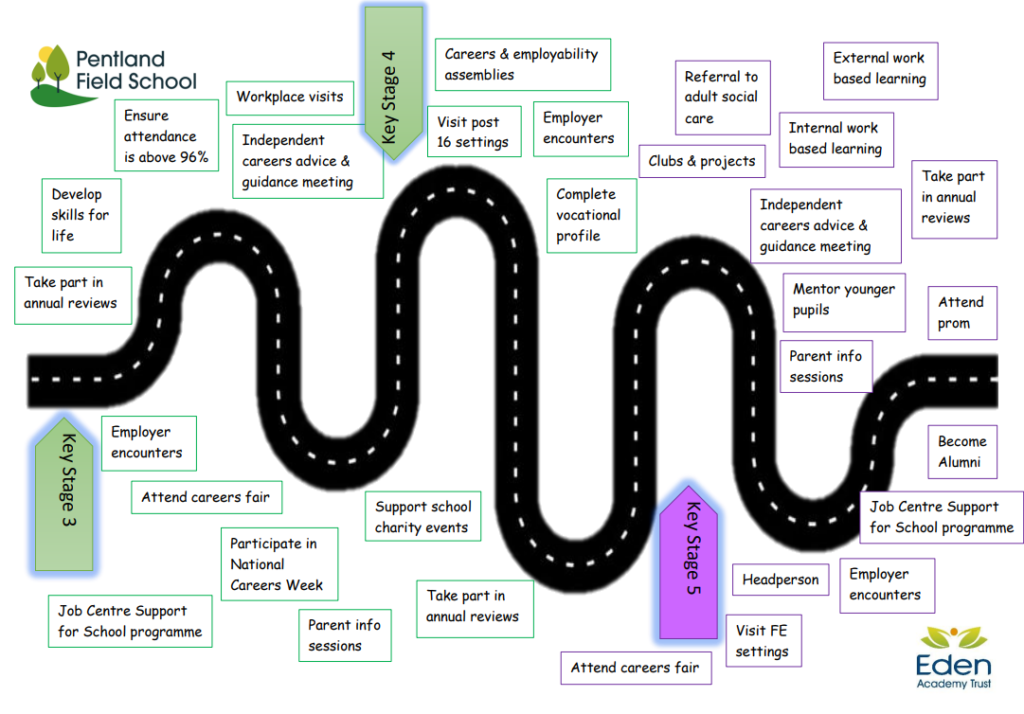
At Pentland Field School the careers education acknowledges the eight Gatsby Benchmarks when planning for our Careers, Education, Information and Guidance (CEIAG) programme.
The CEIAG programme at Pentland Field School is reflective of the person-centred planning approach the school adapts when working within the Preparing for Adulthood framework.
Core Employability skills are incorporated across the curriculum and through the Skills Builder programme to promote and develop pupils skills, in preparation for whatever pathway they are on. These are skills not only for employment but for life.
Celebrating Success – Destinations Data
From year 9, we use annual reviews, Preparing for Adulthood meetings and 1:1 careers advice and guidance sessions to monitor students’ projected pathways and schedule interventions to ensure that they are on the pathway best suited to their skills, interests and ambitions.
This enables us to maximise the quality and choice of destination planning for students before they leave us.
Destination data informs us of the number of past students who have taken different routes and sustained those options.
Importantly it informs us about pupils who have not successfully sustained a placement on a chosen route, giving us insight over time as well as a better understanding of where our students go and what they do after leaving school at 16 or 18/19.
This helps to determine if the careers provision given to students was right for those individuals and feeds into the evaluation cycle.
Work-based learning is one of the most effective ways of preparing young people with SEN for employment
Work Experience
Students are expected to do work experience or some form of work-related training as part of their 16 to 19 study programmes, as appropriate to their needs.
At PFS we aim to broaden the employment horizons of all students by providing access to some type of work experience which is “relevant and meaningful”, using approaches such as:
- Encounters with Employers
- Taster opportunities
- Internal work based learning including the onsite Tuck Shop and Cafe mornings
- External work based learning
- Volunteering opportunities
- Work shadowing
- Exploring entrepreneurial options/Enterprise opportunities
Work-based learning is one of the most effective ways of preparing young people with SEN for employment. Our person centred approach to planning in Key Stage 3/4/5 ensures staff understand the student’s potential, abilities, interests and areas they want to develop.
This allows placements and opportunities to be carefully matched to students and informs honest conversations with potential employers and further education providers.
If you are an employer and are able to offer a workplace learning opportunity, please email mariam.fayeq@pentlandfieldschool.co.uk
By embedding the Benchmarks throughout our Study Programmes, our students will be better equipped and enabled to make their first successful steps into the world of work.
Meeting the Gatsby Benchmarks
The Department for Education adopted the Gatsby Benchmarks as the best practice model for delivering effective careers provision. The Benchmarks are at the heart of the Government’s Careers Strategy, published in 2017, and form the framework for best practice and good embedded careers guidance.
By embedding the Benchmarks throughout our Study Programmes, our students will be better equipped and enabled to make their first successful steps into the world of work.
- A stable careers programme – Careers education is embedded within our core teaching and learning activities and is supported by a stable programme of careers, progression and employability activities. The Careers lead has strategic responsibility for overseeing the programme, which is approved by the board of governors and has the explicit backing of the senior leadership team.
- Learning from career and labour market information – Students, parents and guardians have access to good quality up to date and impartial information about
potential career paths and future study options. Students take part in Employability sessions with a Schools and Colleges Adviser from The Job Centre+. - Addressing the needs of each student – We meet the needs of each student by ensuring they have access to impartial careers guidance at each significant stage of their learner journey. Students are able to build and develop their ‘Vocational Profile’ through our embedded programme of careers, pupil voice and preparing for adulthood activities. This programme actively challenges stereotypical thinking and raises aspirations. We work with a range of professionals who support young people to ensure our students who may be vulnerable are identified and the right career education and guidance is available to them when they need it.
- Linking curriculum learning to careers – Throughout the curriculum pupils will explore how learning links to and will help them to gain entry to a wide range if occupations.
- Encounters with employers and employees – Every student has opportunities for meaningful encounters with employers to learn about work and the skills that are valued in the workplace. Our Careers Programme includes a strong focus on employability tutorials, guest speakers and activities including mock interviews, CV preparation and employer visits.
- Experiences of workplaces – 100% of our Study Programme students have first-hand experiences of the workplace through work visits, work shadowing or work placements to support their exploration of career/enterprise opportunities, and expand their networks.
- Encounters with Further and Higher Education – By the end of their Study Programme, students will have had access to meaningful encounters with a wide range of learning providers including FE colleges, Higher Education, apprenticeship and training providers offering academic and technical pathways. Careers IAG is provided to all students(or their parents/carers) at every level and age which incorporates FE and HE opportunities, specialist support and apprenticeships.
- Personal Guidance – 100% of 16-18 year old students are provided with a range of opportunities for personal guidance interventions with highly qualified careers advisers (Level 6) when significant study or career choices are being made. Careers IAG is available to all students within lessons, online, and face-to-face, to enable students to make well informed decisions and to track their own career progression.
Independent Advice and Guidance
Pentland Field School is committed to providing students with high quality, independent advice and guidance with regards to careers, further and higher education and future life choices. Getting the right advice and guidance is an important part of school life in finding the right pathway at the end of Year 11 and Year 14.
To support this we are working with The Education Development Trust to access their employability and careers services, including specialist careers advice that is accessible and meets the needs of the young people within our setting. The career guidance sessions help us to give our students the information, advice and guidance they need to make informed choices for their future and are offered periodically throughout Key Stage 4 & 5.
Good career guidance can have a profound impact on social mobility, as it ensures that each and every young person, whatever their needs, background or ambitions, knows the options open to them to fulfil their potential.
The Careers Guidance Officer will explore options and advise young people and their parents on areas such as:
- Education and training providers (mainstream and specialist)
- Post 16 and 18/19 course options
- Apprenticeships
- Traineeships
- Supported Internships
- University
- Finishing college and employment applications
- Financial support and transport
- Signposting to agencies to access additional support
Through the schools careers programme, we have achieved some significant outcomes for our students, encouraging them to have high aspirations when planning their pathway through life. The person centred approach encourages pupils to share their dreams and aspirations for the future and the outcomes they achieve reflect this.
Pearse Knocker, Careers & Transitions Lead