Curriculum
Pupils at Pentland Field school learn most effectively when they are able to learn together. Learning is a socially motivated, shared, collaborative experience.
Class sizes are small, currently averaging 10 or 11 pupils per class – with some slightly above or below this number.
A number of factors are considered when grouping pupils into a class: the age of the pupils, their developmental stage and level of emotional maturity at the time, their need for any specific environmental factors, their attainment at that point, and the way in which they communicate with peers.
By planning in this way, the school is aiming to create a social environment in which pupils participate in meaningful, shared learning experiences.
The curriculum is planned in a way that each phase of school Iife prepares pupils for the learning phase that follows next.
Pentland Field School makes provision for pupils with the following range of need:
Formal learners – The formal curriculum is taught as single, discrete subjects, covering: English, Maths, PE, Computing, Science, History, Geography, Art, Design technology and PSHE including RSE.
Semi-formal learners – The semi-formal curriculum covers: Maths, English, Computing, PE, PSHE including RSE, and Life Skills. Maths and English teaching focuses on both the academic knowledge and skills in the curriculum, and the Functional English and Maths key concepts and life skills needed by pupils in order to access the community. Topics are taught in an integrated way and includes Science, Art and Humanities.
The curriculum is planned so that each phase of school Iife prepares pupils for the learning phase that follows next.
Learning is a socially motivated, shared, collaborative experience.
Early Years Foundation Stage and Key Stage 1
Our youngest pupils learn in a way that is sympathetic to some of the best principles of good early years teaching.
We recognise that learning delay means our pupils may need more time to learn in this way, in order to obtain all of the benefits of this.
Formal and Semi-formal pupils learn together. Exploration, discovery, and a structure that emulates a free-flow approach to learning will be in place for pupils of this age, where this is appropriate and practical to do so.
Pupils will continue to work in a way that offers plenty of socialisation and early play opportunities. Some learners may progress to formal learning at the end of Reception whilst others will continue to benefit from the practices of EYFS.
Pupils learn to adjust to
the routines and expectations of school life
Key Stage 2
From year 3 onwards, pupils will follow the school’s core subject curriculum;
Pupils follow the school’s single-subject curriculum.
A single-subject curriculum is extended through the school for pupils on the formal learning pathway from this point.
Teaching staff have the flexibility to teach in a formal or semi-formal way, according to the learning needs of the pupils they are teaching.
In many classes, a combination of approaches is required.
During this key stage, pupils learn to adjust to the routines and expectations of school life, gaining learning skills and basic skills in English and Maths that will support their learning for the rest of their time at school.
Key Stage 3
From year 7 onwards, the curriculum continues to follow the core, discrete and integrated learning structures. Some pupils will have matured to the point that they are able to benefit from a teaching delivery that is more formal in it’s approach. For others, it becomes clear that their developmental journey and type of learning needs means that they will continue to require a semi-formal approach to teaching and learning.
Careers planning begins to have more of a focus in KS3, in line with Gatsy Benchmark expectations, and pupils are helped and encouraged to take part in the Skills Builder programme, helping pupils to identify their strengths and areas for improvement.
By year 9, pupils will be actively included in Preparation for Adulthood planning, which is a part of the Annual Review process. This thread will continue for the rest of a pupil’s time at Pentland Field. Rigour in the curriculum means pupils are prepared for challenges at the next phase of schooling.
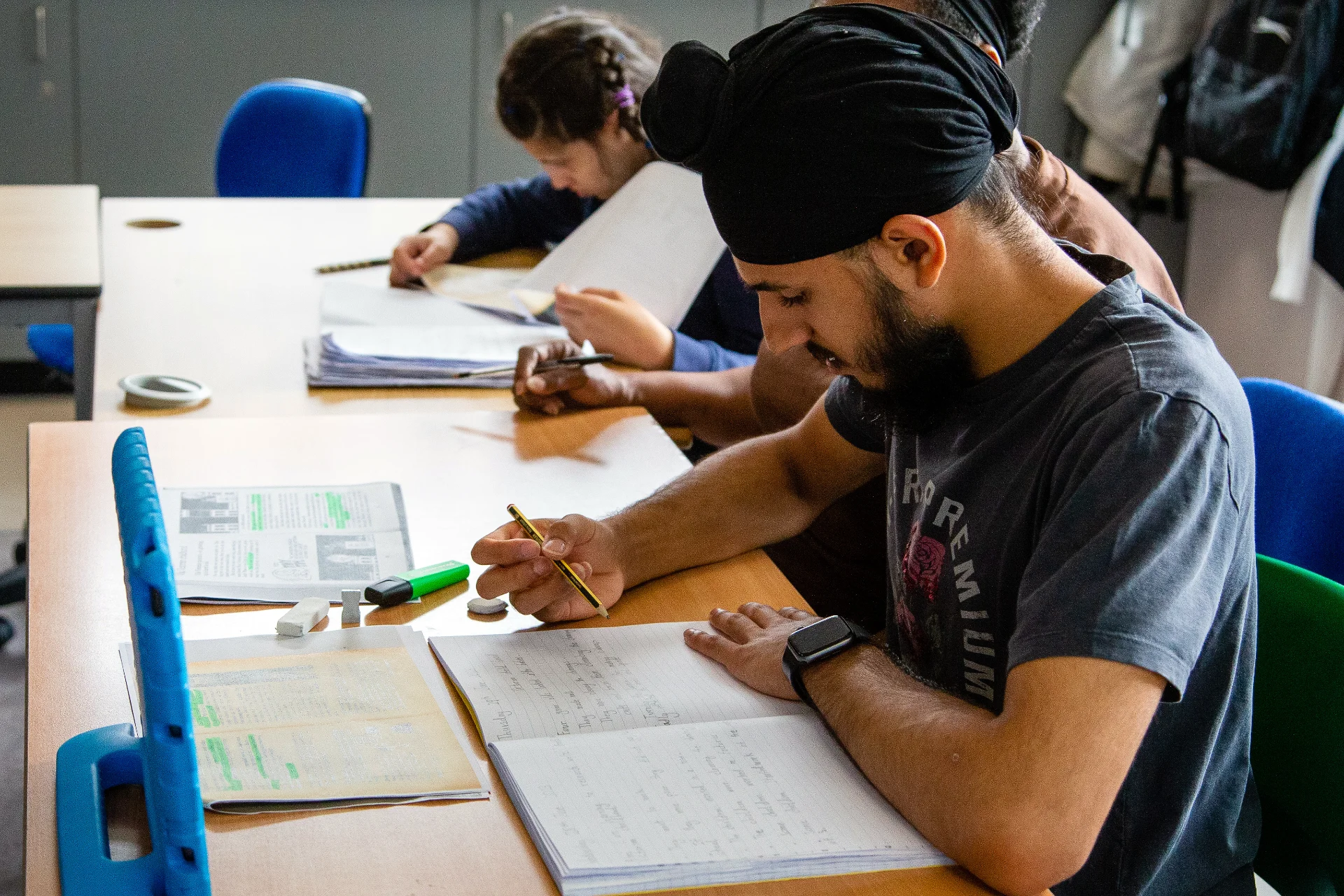
The Skills Builder programme helps pupils to identify their strengths and areas for improvement

Key Stage 4
From year 10, pupils learning the core curriculum begin an appropriate AQA unit certification or qualification and accreditation courses in English and Maths, ranging from Entry Level 1 to Entry Level 3.
Deciding which option to take is based on pupil knowledge and skill , and progress over time, and level of need. This then offers formal or semi-formal learning opportunities for pupils, with both pathways offering stretch and challenge for pupils, designed to move them forward based on what they need to learn next.
Pupils at KS4 have access to careers guidance, organised by the careers lead within the school. During this time, pupils and families are given relevant Information about possible further education options and providers for KS5, as well as signposting options for when many pupils will leave the school at the end of KS5.
Key Stage 5
From year 12, the English and Maths curriculum offers Functional Skills Entry level 1 to Level for students in the Sisu Pathway. Students in the Ikigai and Ubuntu Pathways study Functional Literacy and Functional Numeracy. In addition, pupils in the Ikigai Pathway follow the Realising Aspirations programme.
All pupils follow a functional learning curriculum, which combines appropriately pitched academic rigour with preparation for life after Pentland Field, and as such focuses on key life skills.
Pupils are encouraged to match their learning with planning for the future. Pupils regularly spend time in the community, and are offered work experience placements.

To learn more about Key stage 5, please see our Post 16 section.

Life after Pentland
The school plans carefully so that no pupils are left not without education, employment and training opportunities (NEET).
To learn more about life after Pentland, please see our careers section.